Frenchmans Reef & Morning Star Marriottã‚â® Beach Resort Reviews
| La Perouse Sydney, New Southward Wales | |||||||||||||||
|---|---|---|---|---|---|---|---|---|---|---|---|---|---|---|---|
 Bare Island Fort, Botany Bay | |||||||||||||||
| Map | |||||||||||||||
| Population | 399 (2016 census)[1] | ||||||||||||||
| Postcode(s) | 2036 | ||||||||||||||
| Acme | 12 one thousand (39 ft) | ||||||||||||||
| Location | 14 km (9 mi) south-e of Sydney CBD | ||||||||||||||
| LGA(south) | City of Randwick | ||||||||||||||
| State electorate(s) | Maroubra | ||||||||||||||
| Federal sectionalization(s) | Kingsford Smith | ||||||||||||||
| |||||||||||||||

La Perouse is a suburb in due south-eastern Sydney, in the state of New S Wales, Commonwealth of australia. The suburb of La Perouse is located about fourteen kilometres (8.7 mi) southeast of the Sydney primal business commune, in the Metropolis of Randwick.
The La Perouse peninsula is the northern headland of Botany Bay. It is notable for its former military machine outpost at Blank Island and the Kamay Botany Bay National Park. Congwong Bay Beach, Little Congwong Beach, and the beach at Frenchmans Bay provide protected swimming areas in Botany Bay. La Perouse is 1 of few Sydney suburbs with a French name, others existence Sans Souci and Vaucluse. Kurnell is located opposite, on the southern headland of Botany Bay.
History [edit]
La Perouse was known as "Gooriwal" to the Muruora-dial people of the surface area.[two] The Gameygal or Kameygal clan of the Dharawal people probably lived between the mouth of the Cooks River and present-solar day La Perouse,[three] including the La Perouse area.[iv]
La Perouse was named after the French navigator Jean-François de Galaup, comte de Lapérouse (1741–88), who landed on the northern shore of Botany Bay west of Blank Isle on 26 January 1788. Helm Arthur Phillip and the showtime armada of convicts had arrived in Botany Bay a few days earlier. Louis 16 of France had commissioned Lapérouse to explore the Pacific.[5] In April 1770 James Melt's expedition had sailed onto the east coast of Australia whilst exploring the due south Pacific searching for Terra Australis or 'Country of the South'. Upon King Louis Sixteen'southward orders, Lapérouse departed Brest, French republic, in command of the Astrolabe and Boussole on one August 1785 on a scientific voyage of the Pacific inspired past the voyages of Melt. La Perouse in Sydney's due south is named after the leader of this French trek.
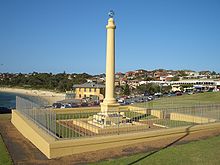
La Perouse Monument, view to Frenchmans Bay
Lapérouse's 2 ships sailed to New South Wales later on 12 of his men had been attacked and killed in the Navigator Islands (Samoa). Astrolabe and Boussole arrived off Botany Bay on 24 January just six days after Captain Arthur Phillip (1738–1814) had anchored just west of Bare Island, in HMSSupply. On 26 January 1788, as Captain John Hunter was moving the Get-go Fleet effectually to Port Jackson after finding Botany Bay unsuitable for a Settlement, Lapérouse was sailing into Botany Bay,[vi] [7] [8] [9] anchoring at that place simply 8 days after the British had.
The British received Lapérouse courteously, and offered him whatsoever assistance he might need. The French were far meliorate provisioned than the British were, and extended the same courtesy but obviously neither offer was accustomed.[ten] The commander of the Fleet, Captain Phillip, ordered that ii British naval vessels, HMSSirius and Supply, meet the French. Contrary to popular belief, the French did not have orders to claim Terra Australis for France and the arrival of the French ships Astrolabe and Boussole and their meeting with the ships of the British expedition was cordial and followed normal protocols. Lapérouse later sent his journals and letters to Europe with the British send, the Sirius.


View to Port Botany at dusk

Another perspective of Bare Island Fort.
The trek's naturalist and chaplain, Father Louis Receveur, died in Feb afterward a skirmish the previous December in Samoa with the inhabitants, in which Paul Antoine Fleuriot de Langle, commander of Astrolabe and 12 other members of the French expedition were killed. Receveur, injured in that skirmish, died at Botany Bay and was buried at Frenchmans Cove below the headland that is now called La Perouse, non far from the Lapérouse Museum. The place was marked by a can plate merely the local Aboriginal people quickly removed it. The British replaced it with some other and tended the site. In 1824, the tree was inscribed by Victor-Charles Lottin (1781–1846), an ensign visiting with Louis Isidore Duperrey. The following year, Hyacinthe de Bougainville paid for the tombstone that is on the site today. Information technology was designed past Government Architect George Cookney (1799–1876).[11] Receveur was the second European to exist buried on the Due east Declension of Commonwealth of australia, the get-go being Forby Sutherland from Cook's 1770 expedition who is buried at nearby Kurnell on the other side of the Botany Bay headlands.
The French stayed at Phytology Bay for six weeks and built a stockade, observatory and a garden for fresh produce on what is now known equally the La Perouse peninsula. After completing the building of a longboat (to replace i lost in the set on in the Navigator Islands) and obtaining wood and h2o, the French departed for New Caledonia, Santa Cruz, the Solomons, and the Louisiades. Lapérouse wrote in his journals that he expected to be back in France past Dec 1788, simply the two ships vanished. The last official sighting of the French trek was in March 1788 when British lookouts stationed at the South Caput of Port Jackson saw the trek canvass from Botany Bay. The French trek was wrecked a short time later on the reefs of Vanikoro in the Solomon Islands during a cyclone sometime during Apr or May 1788, the circumstances remained a mystery for forty years.[12] Some of the mystery was solved in 1826 when items associated with the French ships were plant on an island in the Santa Cruz group, with wreckage of the ships themselves discovered in 1964.[13]
More than recently two major expeditions have been mounted to explore the sites in Vanikoro. In May 2005, the wreck was formally identified every bit that of the Boussole.[xiv] The 2005 expedition was embarked aboard Jacques Cartier, a French naval vessel. The ship supported a multi-discipline scientific team to investigate the "Mystery of Lapérouse".[15] The mission was called "Opération Vanikoro-Sur les traces des épaves de Lapérouse 2005". A farther similar mission was mounted in 2008.[sixteen] [17] [18] Betwixt sixteen September and 15 October 2008 two French Navy boats ready out from Nouméa (New Caledonia) for a voyage to Vanikoro, recreating that section of the terminal journey of discovery made by Lapérouse.[17] [19] [twenty] [21]
Early on subdivision plans [edit]
-

Cable Station Estate, La Perouse – Yarra Rd, Elaroo Ave, Wybalena Ave, Walmarie Ave, 1915-1918
-

La Perouse – Crown Lands and Upset Prices – Canara Ave, Adina Ave, Elaroo Ave, Coonda Ave, Aboricine Ave, Coorawahl St, Bunnerong Rd, Yarra Junction, 1918
Historic structures [edit]
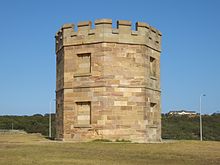
La Perouse's 19th century Customs belfry, used to combat smugglers

Vaulted ammunition storage rooms and gunpowder magazines of the Henry Head Battery, La Perouse

The first edifice in the area was the octagonal stone tower constructed in 1820–22 as accommodation for a pocket-size guard of soldiers stationed there to forestall smuggling, and the tower still stands today.[22] By 1885, an Aboriginal reserve had been established in the suburb and a number of missions were operated in the area. The original church was dismantled and moved to the corner of Elaroo and Adina Avenues, where it still stands. It is known as the La Perouse Mission Church.
A kiosk was built in 1896 to cater for tourists who came to see the attractions, including snake-handling shows.[23] During the Not bad Low, from the late 1920s, many severely affected depression-income families took up residence here in settlements beside the Aboriginal reserve.
The small island simply inside the heads was described by Captain James Cook equally "a small bare island". Bare Island was fortified in 1885, according to a design by colonial architect, James Barnet (1827–1904), and fitted with heavy guns. In 1912 Bare Island became a retirement home for war veterans, which continued to operate until 1963, when it was handed over to the New South Wales Parks and Wild fauna Service for utilise as a museum and tourist attraction.[24]
Apart from the fortification on Blank Isle two other fortifications are located within La Perouse, one of them, Fort Banks is located on Greatcoat Banks. This facility was part of the Eastern Command Stock-still Defences unit, it was designed and positioned in a mode that would allow it to protect the approaches to Botany Bay in the event of a ocean born assault during the World War II menses. Henry Caput Battery, constructed 1892–1895, operated until 1910, when the fort became obsolete. The battery along with two gun-emplacements and ascertainment posts was recommissioned for use during the second World State of war.[25]
Heritage listings [edit]
La Perouse has a number of heritage-listed sites, including:
- Blank Island Fort[26]
- 46 Adina Avenue: La Perouse Mission Church building[27]
- one-39 Bunnerong Road: Chinese Market Gardens (La Perouse)[28]
Trams [edit]
The old La Perouse tram line branched from Oxford Street at Taylor Foursquare in Darlinghurst to run southward along Flinders Street, and then into its own tram reservation forth the eastern side of Anzac Parade beside Moore Park. Information technology then proceeded down the centre of Anzac Parade through Maroubra Junction, and Malabar to its balloon loop terminus at La Perouse. At Malabar, a single line branched off to serve Long Bay Gaol. The line was double track throughout. The line reached La Perouse in stages from 1900 to 1902. The Loop is the circular track that was built equally part of the Sydney tram terminus at La Perouse. Closure was supported by the NRMA, just generally went confronting public opinion. Nevertheless, closure became Labor government policy and the system was wound downward in stages, with withdrawal of the concluding service, to La Perouse in 1961. The line followed the current route of passenger vehicle 394.
Population [edit]
According to the 2016 demography of Population, there were 399 people in La Perouse.
- Aboriginal and Torres Strait Islander people made up 37.4% of the population.
- 76.4% of people were born in Australia and 78.half-dozen% of people spoke just English at home
- The virtually mutual response for religion was No Faith (30.7% of the population).[1]
Attractions [edit]
The La Perouse Museum contains maps, scientific instruments and relics recovered from French explorers. A walking trail from the museum to the Endeavor Lighthouse has views beyond the bay to the site of Captain Melt's Landing Place. The large Lapérouse Monument is an obelisk erected in 1825 by the French, located close to the museum.[29] Another memorial marks the grave of Father Receveur.[xxx] The fortified Blank Island is linked by a footbridge. The museum was originally built as cable station to house the functioning of the starting time submarine telegraph communications cable laid between Australia and Nelson in New Zealand. This cable likewise served every bit the first link in telegraph communications between New Zealand and the remainder of the globe. After the cessation of telegraph communications, the building served as a domicile for orphans run by the Salvation Regular army, with the children attending La Perouse Public Schoolhouse when this first opened in the early 1950s.[31] [32]
Visitors tin can learn about the Indigenous significance of the area from the Ancient people of the area, with boomerang-throwing demonstrations often held on weekends and Aboriginal guided tours operating from Yarra Bay House during the calendar week. Aboriginal artefacts are produced and sold by locals. The Ophidian Man of La Perouse has an outdoor reptile show is likewise a tourist attraction in the pit, at The Loop, on Dominicus afternoons. The reptile shows were begun by the legendary Professor Fox in the late 19th century and resumed by George Cann simply after the Groovy War in 1918. The tradition was continued by members of the Cann family,[33] until recently, and other snake handlers since.
La Perouse has a few cafés and restaurants effectually the historic precinct, shut to Frenchmans Bay.
The New Due south Wales Golf Club, a links–manner golf game form, is at La Perouse, facing both Phytology Bay and the Tasman Sea.
Scuba diving [edit]
The area around the La Perouse peninsula is considered to be one of the best scuba diving sites in NSW.[34] Bare Island has a number of dive sites, some of which extend to over 19 metres in depth. The reef effectually the area is extensive. At that place are too a number of dives around the mainland at La Perouse. Scuba divers here can see the common (weedy) sea dragon, pygmy pipefish, big-belly seahorses and other fish common in the Sydney surface area.[34]
Lilliputian Congwong Beach is popular for snorkeling, and it has also been used for decades every bit an unofficial nude beach.[35]
In pop culture [edit]
- Several scenes from Mission: Impossible 2 (2000) were filmed in La Perouse, including Bare Island.[36]
Notable residents [edit]
- Matthew Melt (built-in 2004), thespian and comedian
- Kevin Longbottom, (1940−1986), rugby league thespian
- Lola Ryan (1925−2003), shellworker
- Emma Timbery (c. 1842−1916), Ancient shellworker and matriarch
- Esme Timbery (born 1931), shellworker
Meet also [edit]
- Ancient Cultural Heritage Act 2003
References [edit]
- ^ a b Australian Bureau of Statistics (27 June 2017). "La Perouse (Land Suburb)". 2016 Census QuickStats . Retrieved 17 December 2018.
 Cloth was copied from this source, which is available under a Creative Commons Attribution 4.0 International License.
 - ^ "A place called Gooriwal | At The Beach". www.migrationheritage.nsw.gov.au . Retrieved 5 April 2017.
- ^ Muir, Lesley (2013). "Aboriginal people of the Cooks River valley". Dictionary of Sydney. Dictionary of Sydney Trust. Retrieved 7 May 2021.
- ^ Kensy, Julia (7 May 2021). "La Perouse". The Dictionary of Sydney . Retrieved vii May 2021.
- ^ "L'expédition de Lapérouse, 1785–1788". Canalacademie.com. Retrieved three June 2014.
- ^ Tench, Watkin; Fitzhardinge, L. F (1961). Sydney's offset iv years. Angus and Robertson, in association with the Majestic Australian Historical Order.
- ^ Peter Dillon's report 1826
- ^ Captain John Hunter's Journal 1793
- ^ The voyage of Governor Phillip to Phytology Bay-printed for John Stockdale 1789
- ^ Loma, David (2009). 1788 : the cruel truth of the Offset Fleet. William Heinemann. ISBN978-i-74166-800-ane.
- ^ Duyker, Edward (2011). Père Reçeveur: Franciscan, Scientist and Voyage with Lapérouse. Engadine, NSW: Dharawal Publications. ISBN978-0-9870727-0-2.
- ^ "1788 Atlas du Voyage de Lapérouse | Commonwealth of australia's migration history timeline | NSW Migration Heritage Centre". Migrationheritage.nsw.gov.au. Retrieved 3 June 2014.
- ^ Wéry, Claudine (vii April 2005). "What news of Lapérouse?". The Guardian. London.
- ^ "Lapérouse wreck identified in Solomon Is". ABC News on-line. 10 May 2005. Archived from the original on eleven May 2005.
- ^ Wéry, Claudine (seven April 2005). "What news of Lapérouse?". London: Guardian Weekly. Retrieved 27 October 2012.
- ^ "Le mystère Laperouse: Vanikoro 2008: REPORT DE LA MISSION". Lemysterelaperouse.blogspot.com. three May 2008. Archived from the original on 8 July 2011. Retrieved 3 June 2014.
- ^ a b "operationlaperouse2008.fr". Archived from the original on 21 October 2016. Retrieved 24 July 2010.
- ^ Vale Reece Discombe (1919-2007) - Pacific Manuscripts Bureau Newsletter, Room 4201, Coombs Edifice (9), Research Schoolhouse of Pacific and Asian Studies, The Australian National University, Canberra Deed 0200 Australia
- ^ "Launch of the "Lapérouse 2008" Functioning". Eramet.fr. Archived from the original on 15 Apr 2012. Retrieved 3 June 2014.
- ^ "Launch of "Lapérouse 2008-Press Society de France to launch Operation Lapérouse 2008, attended by Admiral Jean-Louis Battet" Operation". Archived from the original on 15 April 2012. Retrieved 24 July 2010.
- ^ Le mystère Lapérouse, enquête dans le Pacifique sud (Musée de la Marine - Paris)
- ^ "Macquarie Watchtower". New Southward Wales Heritage Database. Part of Surround and Heritage.
- ^ Adele Horin (18 April 2010). "No Cann practise whatsoever more equally serpent man farewells family tradition". The Sydney Morning Herald. Archived from the original on x Oct 2014.
- ^ The Book of Sydney Suburbs, Compiled by Frances Pollon, Angus & Robertson Publishers, 1990, Published in Australia ISBN 0-207-14495-eight, folio 149
- ^ "History". nswgolfclub.com.au. Archived from the original on 15 Apr 2021. Retrieved iii June 2014.
- ^ "Bare Isle Fort". New S Wales State Heritage Register. Role of Environment & Heritage. H00978. Retrieved 18 May 2018.
- ^ "La Perouse Mission Church building". New South Wales State Heritage Register. Office of Environs & Heritage. H01893. Retrieved xviii May 2018.
- ^ "Chinese Market Gardens". New South Wales Country Heritage Register. Part of Environs & Heritage. H01299. Retrieved 18 May 2018.
- ^ "La Perouse Memorial". New Due south Wales Heritage Database. Part of Environment and Heritage.
- ^ "Tomb of pere le Receveur". New South Wales Heritage Database. Office of Environment and Heritage.
- ^ "La Perouse Museum". Sydney.com. Retrieved 27 October 2012.
- ^ "Laperouse Museum". Museums & Galleries NSW. Retrieved 27 October 2012.
- ^ Cann, John (24 January 2018). The last ophidian man : the remarkable true-life story of an Aussie fable and a century of snake shows. Sydney. ISBN9781760630515. OCLC 1014018699.
- ^ a b Phelan, Liam (12 January 2017). "Sydney's underwater wonderland: acme five diving sites in the city". The Sydney Morning Herald . Retrieved 15 August 2021.
- ^ "half dozen Beautiful Nude Beaches in Sydney". Sydney Uncovered. 30 August 2020. Retrieved 2 Baronial 2021.
- ^ "The Sydney Morning Herald Blogs: Entertainment". Blogs.smh.com.au.

External links [edit]
Coordinates: 33°59′35″Due south 151°14′36″E / 33.99306°South 151.24333°E / -33.99306; 151.24333
- Julia Kensy (2008). "La Perouse". Dictionary of Sydney . Retrieved 27 September 2015. [CC-By-SA]
- Naomi Parry (2015). "Yarra Bay House". Dictionary of Sydney. Lexicon of Sydney Trust. Retrieved 16 October 2015. [CC-By-SA]
- "La Perouse - Sydney.com".
- Guide to Sydney Beaches
- "Sand in our Souls - the Beach in Australian History" Leone Huntsman, MUP, 2001
colemanthishatthe.blogspot.com
Source: https://en.wikipedia.org/wiki/La_Perouse,_New_South_Wales
0 Response to "Frenchmans Reef & Morning Star Marriottã‚â® Beach Resort Reviews"
Post a Comment