Apple Macbook Pro 133-inch Laptop Intel Core I7 29ghz Review
Apple MacBook Pro 13 (Late 2016, 2.9 GHz i5, Bear upon Bar) Notebook Review
The improve 13-inch Pro? The MacBook Pro 13 Touch Bar is Apple'southward new 13-inch flagship model. As well the obvious OLED display above the keyboard, still, there are more differences compared to the entry-level model with function keys. Is it worth the $300 premium?
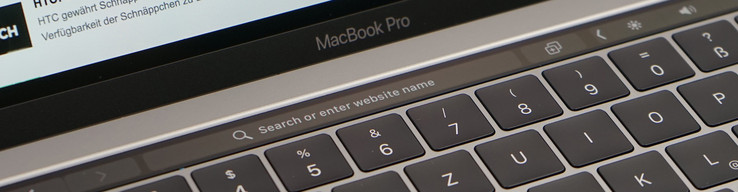
Later nosotros already reviewed two new MacBook Pros (MacBook Pro 15 and MacBook Pro 13 without Bear on Bar), the new MacBook Pro 13 Impact Bar was finally delivered, too. Besides every bit the OLED brandish above the keyboard, which replaces the conventional function keys, there are more differences compared to the entry-level model. This includes two additional Thunderbolt three ports besides as a slightly smaller bombardment (49.two vs. 54.5 Wh). The Impact Bar model is as well equipped with faster processors and a more than powerful Intel Iris GPU. Intel's new Kaby Lake chips, nonetheless, are not available for the MBP 13 Touch Bar.
Our test model was once again ordered in Apple tree's online shop (no printing sample). We got the smallest configuration, only it is far abroad from inexpensive at $1799. In return, yous get a two.nine GHz Intel Cadre i5 processor (dual-core) with the Iris 550 GPU. Otherwise, the performance figures are pretty similar. One interesting aspect is the internal design though, because it differs quite a lot from the thirteen-inch model without Touch Bar. Nosotros refer to our colleagues from iFixit at this point; they take already disassembled both versions.
| MacBook Pro 13 without Touch Bar | MacBook Pro 13 Touch Bar | MacBook Pro 13 (quondam model) | |
| Processor | Cadre i5 ii.0 GHz (Skylake, 15 W) Core i7 2.four GHz (Skylake, 15 W) | Core i5 2.9 GHz (Skylake, 28 W) Core i5 three.1 GHz (Skylake, 28 W) Core i7 three.iii GHz (Skylake, 28 W) | Cadre i5 2.seven GHz (Broadwell, 28 Due west) Core i5 two.nine GHz (Broadwell, 28 W) Core i7 3.ane GHz (Broadwell, 28 W) |
| Graphics card | Intel Iris Graphics 540 | Intel Iris Graphics 550 | Intel Iris Graphics 6100 |
| RAM | 8 GB LPDDR3-1866 16 GB LPDDR3-1866 | 8 GB LPDDR3-2133 16 GB LPDDR3-2133 | 8 GB LPDDR3-1866 16 GB LPDDR3-1866 |
| SSD | 256 GB 512 GB ane TB | 256 GB 512 GB 1 TB | 128 GB 256 GB 512 GB ane TB |
| Display | 13.three-icnh IPS 2560 x 1600 pixels | 13.3-inch IPS 2560 x 1600 pixels | 13.iii-inch IPS 2560 x 1600 pixels |
| Ports | 2x Thunderbolt three with USB-C jack 3.5 mm headset | 4x Thunderbolt 3 wit USB-C jack 3.v mm headset | 2x Thunderbolt ii 2x USB 3.0 MagSafe HDMI SD-menu reader 3.5 mm headset |
| Price | starts at $1499 | starts at $1799 | starts at $1299 |
Besides the differences compared to the MacBook Pro 13 without Impact Bar and the predecessor (which is still available), we are particularly interested in the new dynamic OLED brandish above the keyboard. Does it really meliorate workflow, or is it more of a gimmick that actually complicates things in do?
Change log
- eleven/26 20:00 CET – Bones brandish measurements, PWM, CPU+GPU benchmarks, System Noise, Wi-Fi bombardment runtime
- 11/29 09:30 CET – Temperatures, thermal images, Gaming benchmarks, video runtime and stress examination added
- 11/30 23:30 CET – Wi-Fi performance, power consumption added
- 12/02 22:xxx CET – Battery runtime load, input devices, color gamut
- 12/05 23:thirty CET – Case, viewing angles, SSD, Pros & Cons, Verdict, Rating
Display
13.30 inch sixteen:ten, 2560 x 1600 pixel 227 PPI, APPA033, glossy: yeah
Mainboard
Intel Skylake-U Premium PCH
Weight
1.358 kg ( = 47.9 oz / ii.99 pounds), Power Supply: 269 g ( = 9.49 oz / 0.59 pounds)
Notation: The manufacturer may apply components from unlike suppliers including brandish panels, drives or retention sticks with similar specifications.
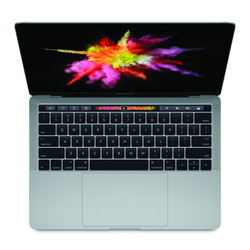
Only the two boosted Thunderbolt 3 ports at the correct side of the chassis point the more expensive model with the Touch Bar, otherwise, the two cases of the new 13-inch MacBook Pros await identical. Besides the familiar version in "Silver", Apple too offers the organisation in the slightly darker "Space Grey". Opening the device is subjectively not different from the sometime model, even though the hinge is at present much thinner. Underneath the display is once once again space for the "MacBook Pro" lettering, which was non the case for the previous Retina models. One time you open the lid, you lot will immediately observe the Touch Bar to a higher place the keyboard besides as the huge trackpad.
Not much changed in terms of quality, because the aluminum unibody chassis is still excellent. This is the case for the design, the tactile feel also as the stability. The Apple logo on the lid is not illuminated anymore and is now glossy, similar to the MacBook 12. Apple does non utilise a plastic embrace for the swivel of the new model anymore, because it is at present completely made of aluminum. The bottom panel is still secured past Pentalobe screws.

Due to the internal differences (different cooling system with second fan, smaller battery etc.), we can measure a weight deviation of 22 grams between the two models of the new MacBook Pro thirteen, but it does no thing at all in practice.
Compared to the other models from Apple'southward lineup, the new Apple MacBook Pro 2016 has much more compact dimensions, both compared to the direct predecessor equally well as the MacBook Air 13. At up to 17 millimeters at its thickest spot, the latter is even 2 millimeters thicker than the new Pro. The weight of the Air 13 and the new MacBook Pro is roughly on par, and the previous MacBook Pro thirteen is almost 200 grams heavier. The new 15-inch model tips the scale at most 1800 grams and therefore 400 grams more than than its xiii-inch counterpart, but it is just one millimeter thicker.
❌
The port option of the new MacBook Pro is probably one of the virtually discussed and criticized changes. Apple equips the new MBP 13 Impact Bar with a total of four Thunderbolt three ports. They are extremely versatile, simply y'all will near likely require (expensive) adapters in the foreseeable future. Reverse to the bigger MacBook Pro 15, at that place seems to be a difference in respect to the Thunderbolt ports, considering Apple says that only the ii ports on the left side support the total Thunderbolt 3 bandwidth. The 2 ports on the right side on the other hand merely back up half of that. Concluding merely not least, you besides get a classic 3.v mm headset port on the correct side.
Although the ports are apparently very versatile, we would have preferred a less radical approach, considering fifty-fifty Apple's own hardware (eastward. g. iPhone or iPad) cannot be fastened without an adapter. Here are some examples for adapters from Apple: USB-C to USB-A adapter: $19, Thunderbolt 3 to Thunderbolt 2 (mDP): $49, USB-C to Gigabit Ethernet: $34.95.
The transfer rates of the MBP 13 Affect Bar are excellent in our standardized WLAN exam (router Linksys EA8500). At effectually 950 Mbps (send/receive), the test model shares the top spot in our comparison with the MacBook Pro 15 (Late 2016). The model without Touch Bar falls behind by virtually 30 %; the Windows contest is even further behind. There is no reason for criticism at an increased altitude, either. The operation in the 2.4 GHz network was even better compared to the MacBook Pro 13 Tardily 2013, which was at the top so far.
Withal, the 13-inch model with the Affect Bar is also affected by the ii.4 GHz WLAN problems when a USB-C device is attached. There can be occasional signal issues both with macOS and Windows. Besides a software issue, this could also be a hardware problem if the USB ports or the WLAN antennas, respectively, are not shielded properly (more than data is available here).
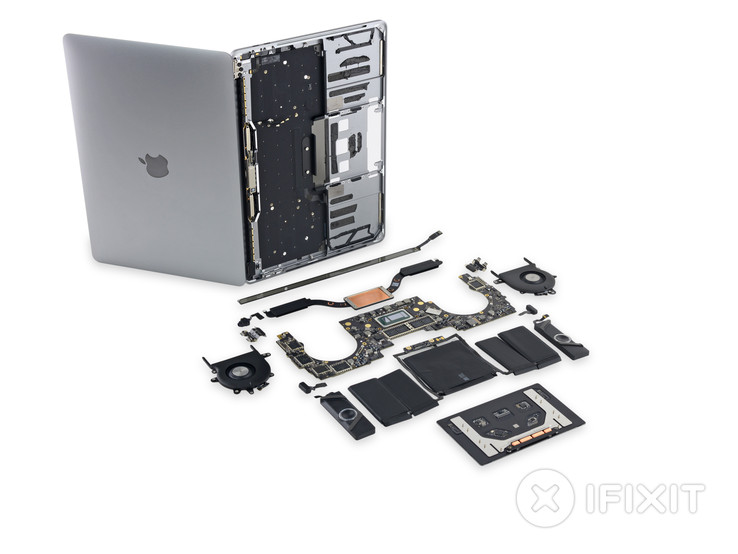
We already mentioned that the internal blueprint of the two new MacBook Pro 13 models differs. The MacBook Pro 13 Bear upon Bar is really basically a smaller version of the MacBook Pro 15. We can detect differences in terms of cooling solution, position of the speakers, the batteries etc.
Because of the additional display and the soldered components – the SSD is soldered here every bit well – the maintainability/reparability is even worse than before. Removing the bottom panel requires a special Pentalobe screwdriver, but you can pretty much only clean the fans. An overview almost all the components is provided in the teardown past our colleagues from iFixit, which is also the source of the following picture.
Apple tree grants a one-year warranty for the MacBook Pro 13. It is possible to extend the warranty menses to three years (including phone support) for $249.
The MacBook Pro 13 is also shipped with the new Butterfly keyboard. Similar to the 12-inch MacBook, the shallow travel of the individual keys will exist a stupor when yous employ it for the first fourth dimension. The very even stroke does leave a positive impression though. This second generation of Apple's own Butterfly machinery was noticeably improved compared to the 12-inch MacBook, only you still have to get used to the typing experience. Later on this has happened, the switch back to the erstwhile MacBook pro is actually pretty difficult, because we now found it to be rather spongy in comparing. We did non notice any differences in typing speed compared to the previous MacBook Pro models, and quick inputs without typos were no problem fifty-fifty in the first session. The typing noise volition depend heavily on your usage scenario. Information technology is slightly louder compared to the quondam model with ten fingers, just we exercise not consider it to be disturbing even in placidity environments. If you lot type forcefully with just ii fingers though, the noise will exist much louder. You lot tin can see a comparison in the video below this department.
Because of the shallow travel, the 16-level keyboard illumination of the individual keys is well implemented into the example and information technology will not dazzle.
The glass trackpad of the new MacBook Pro models is much bigger compared to the previous models, but the technology is otherwise identical. It is nonetheless the reference for a touchpad, even though Windows devices similar the Surface 4 Pro showtime to close the gap. Thanks to the taptic engine, tactile clicks are identical all over the surface and it is as well possible to trigger a firmer "Strength Printing". Both systems work and then well that you do not want to go back to a conventional touchpad with rocker switches. The software back up of the trackpad (in macOS) is besides still unrivaled. Gestures, Elevate & Drop (via 2d finger in the corner) and the response times were excellent in our tests. The palm rejection worked well, only it is also necessary due to the larger surface, because yous will often put a finger or 2 on the touchpad. Adventitious cursor movements were very rare when we used the keyboard.
Touch Bar
Similar to the bigger 15-inch model, our test unit is equipped with the Touch on Bar to a higher place the keyboard, which replaces the office keys. Also familiar special and function keys, information technology can also prove customized options and commands based on the application you use. However, this feature has to be supported by the software and the range is between useful and contemporary right now. A handy function is the indication of the runtime when you lookout videos, for instance.
The hardware itself was well implemented. The surface does characteristic convenient gliding capabilities and the execution was ever smooth and sufficiently quick during our tests. Adjusting the luminance was no problem, either. The use of PWM to adapt the luminance could be an issue for some users though. We tin also notice slight color fringes around the edges of letters.
In that location are drawbacks with the new Touch Bar besides. Especially the "blind" adjustment of the book and the luminance is non possible anymore. The Affect Bar is also deactivated when you lot do not use it for a while to save power, so it requires ii touches to trigger a role (like the Esc key).
All in all, the Affect Bar is currently more of a gimmick in our stance correct now. Notwithstanding, this might modify with meliorate software support. We exercise miss a tactile feedback – like to the trackpad via taptic engine – in general.
Touch ID Sensor
The power push on the right side of the Touch Bar is equipped with the Bear on ID sensor we know from the iPhone. Information technology recognizes the finger print quickly and reliably for authentication. It worked really well in practise, simply the tactile feedback of the button is not perfect.
Every bit expected, the 13.iii-inch IPS displays of the two MacBook Pro models are very like. We can notice another Panel ID (APPA033 vs. APPA034), simply our measurement results do not differ much. We can also encounter the big departure compared to the previous model: The resolution is still 2560x1600 pixels (227 PPI), simply the new models are much brighter at around 550 nits and also beat the Windows contest pretty conspicuously. Our model without Touch Bar was slightly brighter, but the differences can be explained with the usual variation.
You will be happy about the low minimum luminance at only half dozen.1 nits if yous like to piece of work in the dark. The downside of the high luminance is the high black value (0.56 cd/m²) though, and then the dissimilarity ratio (~1000:1) is nonetheless on the (expert) level of the previous version. Some rivals similar the Dell XPS 13 (1489:1), nonetheless, manage improve results. Despite the enormous luminance, which is also bachelor on battery power, we tin mensurate a very adept effulgence distribution of 90%.
| 541 cd/1000² | 547 cd/grand² | 524 cd/m² | ||
| 557 cd/thou² | 569 cd/g² | 528 cd/thou² | ||
| 538 cd/grand² | 567 cd/yard² | 510 cd/yard² | ||
Distribution of brightness
APPA033
X-Rite i1Pro ii
Maximum: 569 cd/thou² (Nits) Average: 542.3 cd/m² Minimum: 6.ane cd/m²
Brightness Distribution: 90 %
Center on Bombardment: 569 cd/m²
Contrast: 1016:1 (Blackness: 0.56 cd/m²)
ΔE Color ane.4 | 0.59-29.43 Ø5.4
ΔE Greyscale 1.viii | 0.64-98 Ø5.6
99.3% sRGB (Argyll ane.6.3 3D)
78.iv% AdobeRGB 1998 (Argyll 1.6.iii 3D)
87.vi% AdobeRGB 1998 (Argyll 2.2.0 3D)
99.9% sRGB (Argyll 2.2.0 3D)
99.two% Display P3 (Argyll 2.2.0 3D)
Gamma: 2.16
| Apple MacBook Pro 13 2016 (ii.9 GHz) APPA033, , 2560x1600, 13.30 | Apple MacBook Pro 13 2016 APPA034, , 2560x1600, 13.30 | Apple MacBook Pro Retina 13 inch 2015-03 APPA02A, , 2560x1600, 13.30 | Dell XPS xiii 9360 QHD+ i7 Abrupt SHP144A, , 3200x1800, xiii.30 | Lenovo ThinkPad X1 Carbon 20FB003RGE VVX14T058J00, , 2560x1440, 14.00 | |
|---|---|---|---|---|---|
| Display | -1% | -20% | -25% | -20% | |
| Brandish P3 Coverage | 99.2 | 97.ane -2% | 65.ix -34% | 62.eight -37% | 66.7 -33% |
| sRGB Coverage | 99.nine | 99.8 0% | 97 -three% | 89.4 -xi% | 94.7 -5% |
| AdobeRGB 1998 Coverage | 87.six | 86.7 -1% | 67.4 -23% | 64.half dozen -26% | 68.4 -22% |
| Response Times | two% | 27% | 31% | ||
| Response Time Grayness 50% / Grey 80% * | 47.2 ? | 47.2 ? -0% | 43.6 ? viii% | 44 ? seven% | |
| Response Time Black / White * | 53 ? | 51.half-dozen ? iii% | 29.2 ? 45% | 24 ? 55% | |
| PWM Frequency | 220 ? | ||||
| Screen | -2% | -12% | -48% | -39% | |
| Effulgence heart | 569 | 600 5% | 361 -37% | 396.2 -30% | 272 -52% |
| Effulgence | 542 | 564 iv% | 342 -37% | 357 -34% | 268 -51% |
| Brightness Distribution | 90 | 89 -one% | 81 -ten% | 84 -7% | 95 six% |
| Blackness Level * | 0.56 | 0.57 -2% | 0.361 36% | 0.266 52% | 0.32 43% |
| Contrast | 1016 | 1053 4% | 1000 -2% | 1489 47% | 850 -16% |
| Colorchecker dE 2000 * | one.4 | ane.5 -vii% | 1.82 -xxx% | 3.nine -179% | 2.61 -86% |
| Colorchecker dE 2000 max. * | 2.9 | 2.9 -0% | 3.26 -12% | vii.58 -161% | six.43 -122% |
| Greyscale dE 2000 * | 1.8 | 2 -xi% | i.viii -0% | iv.16 -131% | iii.31 -84% |
| Gamma | 2.16 102% | 2.27 97% | ii.49 88% | ii.31 95% | 2.35 94% |
| CCT | 6877 95% | 6855 95% | 6417 101% | 6514 100% | 6360 102% |
| Color Infinite (Pct of AdobeRGB 1998) | 78.4 | 77 -2% | 61.9 -21% | 57.5 -27% | 63 -20% |
| Color Space (Per centum of sRGB) | 99.3 | 92 -7% | 96.9 -two% | 88.seven -11% | 95 -4% |
| Total Average (Plan / Settings) | -0% / -1% | -16% / -13% | -15% / -33% | -9% / -26% |
* ... smaller is meliorate
Similar to the version without Impact Bar, nosotros can mensurate very authentic colors out-of-the-box. The average DeltaE-2000 deviations compared to the P3 reference color infinite are just 1.4 for the colors and one.8 for the grayscale, respectively. There are no outliers above the of import marker of three, so a display scale is not required. We tin can make up one's mind slightly wider color gamut compared to the MacBook Pro thirteen with Function Keys. AdobeRGB is covered by 78 %; sRGB most completely (99.3 %).
The IPS display is not specially fast in our tests, merely nosotros like the lack of pulse-width modulation. We cannot even measure any fluctuations of the luminance at the lowest setting. The background illumination of the keyboard does not seem to use PWM, either. Only the Touch Bar should exist (equally per usual for OLED) dimmed by PWM; our oscilloscope shows a clear signal.
Display Response Times
ℹ
Brandish response times show how fast the screen is able to change from one colour to the side by side. Deadening response times can lead to afterimages and can cause moving objects to appear blurry (ghosting). Gamers of fast-paced 3D titles should pay special attention to fast response times.
| ↔ Response Fourth dimension Black to White | ||
|---|---|---|
| 53 ms ... rise ↗ and fall ↘ combined | ↗ 10 ms ascent |  |
| ↘ 43 ms fall | ||
| The screen shows slow response rates in our tests and will be unsatisfactory for gamers. In comparison, all tested devices range from 0.8 (minimum) to 240 (maximum) ms. » 100 % of all devices are amend. This ways that the measured response time is worse than the average of all tested devices (23.5 ms). | ||
| ↔ Response Time 50% Grey to eighty% Grey | ||
| 47.2 ms ... ascension ↗ and fall ↘ combined | ↗ xix.6 ms rise |  |
| ↘ 27.half dozen ms fall | ||
| The screen shows slow response rates in our tests and volition be unsatisfactory for gamers. In comparing, all tested devices range from 0.692 (minimum) to 636 (maximum) ms. » 76 % of all devices are better. This ways that the measured response fourth dimension is worse than the average of all tested devices (37.1 ms). | ||
Screen Flickering / PWM (Pulse-Width Modulation)
ℹ
To dim the screen, some notebooks will simply cycle the backlight on and off in rapid succession - a method called Pulse Width Modulation (PWM) . This cycling frequency should ideally be undetectable to the human middle. If said frequency is as well low, users with sensitive optics may experience strain or headaches or fifty-fifty notice the flickering altogether.
| Screen flickering / PWM non detected |  | ||
| In comparing: 52 % of all tested devices do non utilise PWM to dim the brandish. If PWM was detected, an average of 22039 (minimum: 5 - maximum: 3846000) Hz was measured. | |||
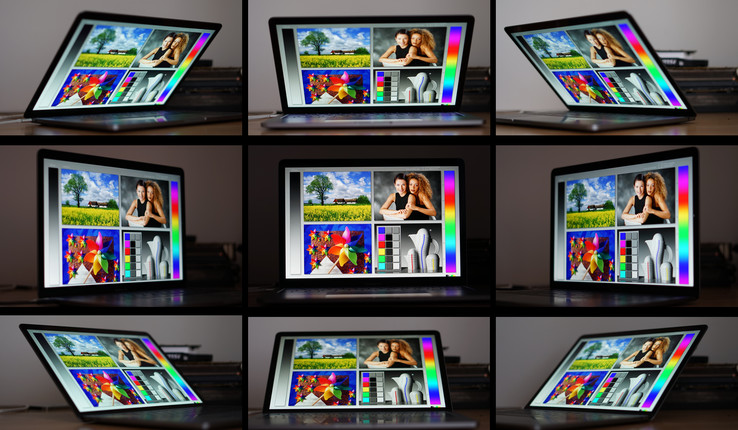
Cheers to the extreme luminance, the MacBook Pro 13 also works pretty well outdoors. At that place are manifestly limitations die to the glossy console surface, and so you should avert reflections from directly light sources. But the wide viewing angles of the IPS display normally ensure that y'all will find a suitable spot.
Notation: The following picture was taken from the MacBook Pro thirteen without Affect Bar, only is also representative for our test model.
The two 13-inch models of the MacBook Pro are equipped with different components, and the Touch Bar model gets faster components in general. This is supported by the processor clock (2.0 vs. 2.nine GHz for the entry-level models), the graphics card (Intel Iris Graphics 540 vs. 550) and the speed of the retention (LPDDR3-1866 vs. LPDDR3-2133).
Quad-cadre processors or dedicated graphics adapters are not bachelor for the MacBook Pro 13 though; they are reserved for the bigger MacBook Pro 15. The memory configurations practice non differ betwixt the models and you tin get up to 16 GB RAM and up to 1 TB SSD storage, but the updates are expensive. The fully-equipped model with Core i7 processor, xvi GB RAM and 1 TB SSD retails for $2899.
The dual-core processor of our test model carries the designation Core i5-6267U. Opposite to the popular ULV processors with a TDP of 15 Watts, this processor can consume upwards to 28 Watts, so information technology has more headroom for the clocks too every bit the integrated GPU. The processor is still based on the Skylake architecture, which was introduced in September 2015. Intel's new Kaby Lake chips are not yet available in 28-Watt configurations, so we will probably have to await for the next refresh to run into them. The high base clock of 2.9 GHz (Turbo up to iii.three GHz) is noticeable, so the fleck should have an advantage compared to the standard ULV models, especially in multithread scenarios.
The processor leaves a very good impression in our initial Cinebench R15 tests in macOS. Afterwards 20 runs (loop), we can see scores between 335-339 points (338 on average), and the maximum score is also reached in the 10th run. Throttling is therefore not a problem. The processor is roughly 10% ahead of the Cadre i5 in the MacBook Pro 13 without Touch Bar.
Cinebench R15 CPU Multi 64Bit
339 Points
Cinebench R15 CPU Single 64Bit
131 Points
Cinebench R15 OpenGL 64Bit
36.9 fps
Cinebench R15 Ref. Match 64Bit
99.3 %
Help
We evaluate the system functioning with PCMark 8 running on Bootcamp Windows. Cheers to the lower display resolution, the Touch on Bar model tin really beat the MacBook Pro 15 in the Habitation test and is at the top of the ranking. The score in the Piece of work test is also very good and all systems are pretty close. No limitations here.
| PCMark eight | |
| Domicile Score Accelerated v2 | |
| Apple MacBook Pro xiii 2016 (ii.ix GHz) | |
| Apple MacBook Pro 15 2016 (two.half dozen GHz, 450) | |
| Lenovo ThinkPad T460s-20FA003GGE | |
| Lenovo ThinkPad X1 Carbon 20FB003RGE | |
| Apple tree MacBook Pro Retina thirteen inch 2015-03 | |
| Razer Blade Stealth QHD i7-7500U | |
| Apple MacBook Pro 13 2016 | |
| Dell XPS xiii 9360 QHD+ i7 | |
| Work Score Accelerated v2 | |
| Lenovo ThinkPad T460s-20FA003GGE | |
| Apple MacBook Pro xv 2016 (2.vi GHz, 450) | |
| Lenovo ThinkPad X1 Carbon 20FB003RGE | |
| Apple MacBook Pro xiii 2016 (two.9 GHz) | |
| Dell XPS 13 9360 QHD+ i7 | |
| Apple MacBook Pro Retina 13 inch 2015-03 | |
| Apple MacBook Pro 13 2016 | |
| PCMark viii Home Score Accelerated v2 | 3738 points | |
| PCMark 8 Work Score Accelerated v2 | 4218 points | |
| Help | ||
The MacBook pro 13 Touch Bar is equipped with the same SSD with Apple'southward own controller nosotros can notice in the other 2016 models. The performance figures of the 256 GB models hardly differ. AS SSD does unfortunately produce some fault messages in many tests, and so some results are incomplete.
Sequential Read: 1662 MB/due south
Sequential Write: 1336 MB/s
CDM 5/6 Read Seq Q32T1: 3055 MB/s
CDM v/half dozen Write Seq Q32T1: 1363 MB/southward
CDM 5/6 Read 4K Q32T1: 495 MB/southward
CDM 5/six Write 4K Q32T1: 364 MB/s
CDM 5 Read Seq: 1765 MB/due south
CDM five Write Seq: 1353 MB/s
CDM five/vi Read 4K: 21.7 MB/s
CDM 5/6 Write 4K: 33.eight MB/s
Sequential Read: 2405MB/s
Sequential Write: 1499MB/south
Access Fourth dimension Read: 0.156ms
Graphics calculations are handled by the integrated Intel Iris Graphics 550 GPU. It is the GT3e model of the Skylake GPU (Intel Gen. 9) with 48 Execution units clocked at up to 1050 MHz. Opposite to the very popular ULV versions like the Hard disk Graphics 520, for example, the Iris Graphics 550 is equipped with 64 MB eDRAM and therefore offers much more than performance. More technical information about the GPU is available in our Tech section.
The 3DMark benchmarks running on Windows (Bootcamp) determine very good results and the MacBook can beat all Windows devices equipped with the Intel iris Graphics 550. The MacBook Pro without Bear upon Bar falls behind past 11-xvi% depending on the test, while the advantage over the previous model with Iris Graphics 6100 is pretty significant (minus 37-xl%).
| 3DMark xi - 1280x720 Performance GPU | |
| Apple MacBook Pro 15 2016 (2.6 GHz, 450) | |
| Apple tree MacBook Pro xiii 2016 (2.9 GHz) | |
| Sony Vaio Z Flip | |
| Acer Aspire V3-372-57CW | |
| Apple MacBook Pro 13 2016 | |
| Asus Zenbook UX310UQ-GL011T | |
| Lenovo Yoga 710-14ISK | |
| Lenovo IdeaPad 510S-14ISK | |
| Apple MacBook Pro Retina xiii inch 2015-03 | |
| Razer Bract Stealth QHD i7-7500U | |
| Dell XPS thirteen 9360 QHD+ i7 | |
| Lenovo ThinkPad X1 Carbon 20FB003RGE | |
| 3DMark | |
| 1280x720 Cloud Gate Standard Graphics | |
| Apple tree MacBook Pro 15 2016 (two.six GHz, 450) | |
| Apple MacBook Pro 13 2016 (ii.nine GHz) | |
| Sony Vaio Z Flip | |
| Acer Aspire V3-372-57CW | |
| Apple MacBook Pro xiii 2016 | |
| Lenovo IdeaPad 510S-14ISK | |
| Lenovo Yoga 710-14ISK | |
| Asus Zenbook UX310UQ-GL011T | |
| Razer Blade Stealth QHD i7-7500U | |
| Dell XPS thirteen 9360 QHD+ i7 | |
| Apple MacBook Pro Retina 13 inch 2015-03 | |
| Lenovo ThinkPad X1 Carbon 20FB003RGE | |
| 1920x1080 Burn down Strike Graphics | |
| Apple MacBook Pro 15 2016 (2.6 GHz, 450) | |
| Apple MacBook Pro xiii 2016 (ii.ix GHz) | |
| Sony Vaio Z Flip | |
| Asus Zenbook UX310UQ-GL011T | |
| Lenovo Yoga 710-14ISK | |
| Acer Aspire V3-372-57CW | |
| Apple MacBook Pro 13 2016 | |
| Lenovo IdeaPad 510S-14ISK | |
| Apple MacBook Pro Retina 13 inch 2015-03 | |
| Razer Blade Stealth QHD i7-7500U | |
| Lenovo ThinkPad X1 Carbon 20FB003RGE | |
| Dell XPS 13 9360 QHD+ i7 | |
| 3DMark 06 Standard Score | 15951 points | |
| 3DMark 11 Operation | 2881 points | |
| 3DMark Cloud Gate Standard Score | 8105 points | |
| 3DMark Fire Strike Score | 1550 points | |
| 3DMark Time Spy Score | 620 points | |
| Help | ||
The gaming benchmarks show an advantage over the MBP xiii with Role Keys, but the test model with the faster Iris 550 GPU is still non a neat gaming motorcar. You should focus on older or less demanding titles like Bioshock Infinite or DOTA 2, which will also run smoothly with High details. Opposite to the synthetic benchmarks, the dedicated GeForce 940MX is faster than the Iris GPU in the gaming tests.
More benchmarks are available in our gaming listing.
| The Witcher iii - 1024x768 Low Graphics & Postprocessing | |
| Asus Zenbook UX310UQ-GL011T | |
| Apple MacBook Pro 13 2016 (2.nine GHz) | |
| Apple tree MacBook Pro 13 2016 | |
| Dell XPS 13 9360 QHD+ i7 | |
| Razer Bract Stealth QHD i7-7500U | |
| BioShock Space - 1366x768 High Preset | |
| Apple tree MacBook Pro 13 2016 (ii.nine GHz) | |
| Sony Vaio Z Flip | |
| Apple tree MacBook Pro 13 2016 | |
| Asus Zenbook UX310UQ-GL011T | |
| Dell XPS xiii 9360 QHD+ i7 | |
| Apple tree MacBook Pro Retina 13 inch 2015-03 | |
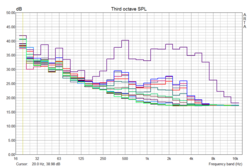
Opposite to the MacBook Pro 13 without Touch Bar, Apple tree equips the more than expensive model with 2 fans. We cannot notice a clattering audio this time. The fans don't spin while idling and with lite workloads co-ordinate to the iStat menus. Even more than challenging workloads, in this instance 30 iterations of the Cinebench R15 benchmark, only result in 2000-2800 rpm and a very quiet 30.8 dB(A) according to our measurement device. 3D load simulated by the Unigine Valley benchmark will result in a seamless rpm increment over time. After about fifteen minutes, the cooling system runs at 4150 and 4500 rpm, respectively, and a quiet 36.8 dB(A). The fans can spin up to 6336 and 6864 rpm and will be quite loud at 47.9 dB(A), just we did not reach this level during our tests then far.
Noise Level
| Idle | xxx.2 / 30.two / 30.2 dB(A) | |
| Load | 33 / 36.two dB(A) | |
 | ||
| 30 dB 40 dB(A) 50 dB(A) | ||
| min: | ||
 , med:
  , max:
The MacBook does non warm upwardly at all while idling or with light workloads and does stay conveniently absurd. Apple was able to recoup the faster components with the second fan, because we can decide almost identical average temperatures of around 36 °C compared to the version without Impact Bar. The rear surface area of the top in particular does become a scrap warmer at up to 45 °C, merely both the palm rest as well as the trackpad are cooler in render. There should one time once more exist no problems when you desire to use the MacBook on your lap.
We use the tools Prime95 and FurMark running on Windows for our stress test, and the MacBook performs very well. Afterward about 2.v hours, nosotros can measure 36.8 dB(A). The tool HWiNFO was unfortunately a bit not working every bit expected and did not log the whole examination, so we cannot give you exact figures for the clocks. Ane interesting attribute is the ability consumption though. Like to other MacBooks, the processor is not limited by the 28-Watt TDP and can consume more power. We saw a steady value of 35 Watts, so throttling is no problem for the exam model.
| |||||||||||||||||||||||||
| Maximum: 45 °C = 113 F Average: 36 °C = 97 F | |||||||||||||||||||||||||
| |||||||||||||||||||||||||
| Maximum: 39 °C = 102 F Boilerplate: 35.6 °C = 96 F | |||||||||||||||||||||||||
Power Supply (max.) fifty °C = 122 F | Room Temperature 19 °C = 66 F | Fluke 62 Mini
| |||||||||||||||||||||||||
| Maximum: 26 °C = 79 F Average: 23.9 °C = 75 F | |||||||||||||||||||||||||
| |||||||||||||||||||||||||
| Maximum: 24 °C = 75 F Average: 23.4 °C = 74 F | |||||||||||||||||||||||||
Power Supply (max.) 26 °C = 79 F | Room Temperature 20 °C = 68 F | Fluke 62 Mini
(±) The average temperature for the upper side under maximal load is 36 °C / 97 F, compared to the boilerplate of 30.6 °C / 87 F for the devices in the class Subnotebook.
(±) The maximum temperature on the upper side is 45 °C / 113 F, compared to the average of 35.7 °C / 96 F, ranging from 21.4 to 58.4 °C for the class Subnotebook.
(+) The bottom heats upwardly to a maximum of 39 °C / 102 F, compared to the average of 39.4 °C / 103 F
(+) In idle usage, the average temperature for the upper side is 23.9 °C / 75 F, compared to the device average of 30.half dozen °C / 87 F.
(+) The palmrests and touchpad are cooler than skin temperature with a maximum of 29 °C / 84.two F and are therefore absurd to the touch.
(±) The boilerplate temperature of the palmrest area of similar devices was 28.3 °C / 82.9 F (-0.7 °C / -1.3 F).
We have already seen the different speaker setups of the two 13-inch models, and the location within the case differs likewise. In practice, y'all mainly detect the higher maximum level (86.9 vs. 83.2 dB(A)), just otherwise, they sound very similar. This is likewise supported by our measurements and the Affect Bar model does convince with very expert audio quality, especially for such a sparse base unit.
Reverse to our exam model of the new MacBook Pro 15, we did not take whatsoever speaker issues on the thirteen-inch model caused by the Windows installation via Kicking Campsite.
Apple MacBook Pro 13 2016 (2.ix GHz) audio analysis
(+) | speakers tin can play relatively loud (86.9 dB)
Bass 100 - 315 Hz
(±) | reduced bass - on average 12.1% lower than median
(±) | linearity of bass is average (x.9% delta to prev. frequency)
Mids 400 - 2000 Hz
(+) | balanced mids - only four.9% abroad from median
(+) | mids are linear (six.iv% delta to prev. frequency)
Highs 2 - 16 kHz
(+) | counterbalanced highs - only iii.1% away from median
(+) | highs are linear (4.1% delta to prev. frequency)
Overall 100 - 16.000 Hz
(+) | overall sound is linear (12.2% deviation to median)
Compared to same class
» 13% of all tested devices in this class were better, 5% similar, 82% worse
» The best had a delta of 7%, average was 19%, worst was l%
Compared to all devices tested
» eight% of all tested devices were ameliorate, ii% similar, 90% worse
» The all-time had a delta of 3%, average was 20%, worst was 65%
Apple MacBook Pro xiii 2016 audio assay
(+) | speakers tin can play relatively loud (83.ii dB)
Bass 100 - 315 Hz
(±) | reduced bass - on average 8.4% lower than median
(-) | bass is not linear (xvi.vii% delta to prev. frequency)
Mids 400 - 2000 Hz
(+) | balanced mids - only 4.seven% away from median
(+) | mids are linear (6.iii% delta to prev. frequency)
Highs ii - sixteen kHz
(+) | balanced highs - merely 1.1% away from median
(+) | highs are linear (2.6% delta to prev. frequency)
Overall 100 - 16.000 Hz
(+) | overall sound is linear (eight.6% divergence to median)
Compared to same class
» one% of all tested devices in this form were ameliorate, 1% similar, 98% worse
» The best had a delta of 7%, average was nineteen%, worst was 50%
Compared to all devices tested
» 2% of all tested devices were meliorate, 0% similar, 98% worse
» The best had a delta of 3%, boilerplate was 20%, worst was 65%
Apple tree MacBook Pro fifteen 2016 (2.vi GHz, 450) audio assay
(+) | speakers tin can play relatively loud (86 dB)
Bass 100 - 315 Hz
(±) | reduced bass - on average 6.six% lower than median
(±) | linearity of bass is boilerplate (12.8% delta to prev. frequency)
Mids 400 - 2000 Hz
(±) | higher mids - on average v.2% college than median
(±) | linearity of mids is average (9.half-dozen% delta to prev. frequency)
Highs 2 - 16 kHz
(+) | counterbalanced highs - only 2% abroad from median
(+) | highs are linear (4.3% delta to prev. frequency)
Overall 100 - 16.000 Hz
(+) | overall sound is linear (9.two% difference to median)
Compared to aforementioned class
» half-dozen% of all tested devices in this class were improve, 0% similar, 94% worse
» The all-time had a delta of 3%, average was xviii%, worst was 41%
Compared to all devices tested
» 2% of all tested devices were amend, 0% like, 97% worse
» The best had a delta of 3%, boilerplate was twenty%, worst was 65%
Frequency comparison (checkboxes select/deselectable)
The MacBook pro thirteen Bear upon Bar manages excellent results in our consumption measurements. Despite the enormous luminance, both the model without Touch Bar likewise equally the predecessor are beaten in the idle tests. We tin notice the faster components under load though, and we can measure out up to lx Watts. The provided 61-Watt ability adapter is therefore just sufficient, but there is non much headroom if you want to charge the battery in this example.
| Apple MacBook Pro thirteen 2016 (2.9 GHz) 6267U, Iris Graphics 550, 2560x1600, 13.30 | Apple MacBook Pro 13 2016 6360U, Iris Graphics 540, 2560x1600, 13.30 | Apple MacBook Pro Retina xiii inch 2015-03 5257U, Iris Graphics 6100, 2560x1600, thirteen.30 | Apple MacBook Air 13 inch 2015-03 5650U, Hard disk drive Graphics 6000, 1440x900, 13.30 | Dell XPS thirteen 9360 QHD+ i7 i7-7500U, HD Graphics 620, 3200x1800, 13.30 | Lenovo ThinkPad X1 Carbon 20FB003RGE 6500U, Hd Graphics 520, 2560x1440, 14.00 | Lenovo ThinkPad T460s-20FA003GGE 6600U, Hard disk drive Graphics 520, 2560x1440, 14.00 | |
|---|---|---|---|---|---|---|---|
| Ability Consumption | -3% | -7% | 21% | -16% | 1% | -ii% | |
| Idle Minimum * | two.i | 3 -43% | 2.eight -33% | 2.7 -29% | 6.4 -205% | three.8 -81% | 3.8 -81% |
| Idle Average * | 7.6 | 8.nine -17% | 7.8 -3% | v.7 25% | 6.6 xiii% | 7.1 7% | 7.1 7% |
| Idle Maximum * | viii.ii | 8.9 -9% | 8.1 1% | vi 27% | 6.8 17% | 7.7 half-dozen% | seven.eight 5% |
| Load Average * | 56.4 | 43.iv 23% | 52.4 seven% | 32.1 43% | 27.v 51% | 30.2 46% | 36.3 36% |
| Load Maximum * | 59.8 | 42.i xxx% | 62.8 -five% | 36.ii 39% | 32.four 46% | 44.7 25% | 46 23% |
* ... smaller is better
Apple advertises a runtime of 10 hours for both 13-inch models of the new MacBook Pro. The smaller version with the function keys easily lasts that long (11.v hours), simply the Touch Bar model just misses it. Our WLAN test determines little more than 9.5 hours. This is still a very skilful consequence, and it even beats the old MBP 13, despite the significantly lower battery capacity. Dell's XPS 13 is pretty close, while the two rivals from Lenovo are conspicuously beaten.
The Touch Bar models performs a chip worse in the video exam (8:03 hours) compared to the WLAN test. Not merely the does the less expensive version without the additional OLED panel lasts longer, but also the predecessor as well as the X1 Carbon from Lenovo. Hither we tin can notice the reduced battery capacity.
The MacBook can maintain its functioning level in demanding games, merely the battery is drained pretty apace in return. The Witcher 3 (lowest details) ran at a steady 20-21 FPS and 152 nits for i hour and 14 minutes. The remaining battery capacity was 7 %, and the system shut down 1-2 minutes and could not exist started due to the depression battery capacity. past the way, the MacBook Pro 13 without Touch Bar lasted much longer with similar settings (1 hour 51 minutes).
Bombardment Runtime
| WiFi Websurfing | 9h 26min | |
| Large Cadet Bunny H.264 1080p | 8h 03min | |
| Load (maximum brightness) | 1h 06min |
| Apple MacBook Pro 13 2016 (two.9 GHz) 6267U, Iris Graphics 550, 49.2 Wh | Apple MacBook Pro 13 2016 6360U, Iris Graphics 540, 54 Wh | Apple MacBook Pro Retina 13 inch 2015-03 5257U, Iris Graphics 6100, 75 Wh | Apple MacBook Air 13 inch 2015-03 5650U, Hard disk drive Graphics 6000, 54 Wh | Dell XPS 13 9360 QHD+ i7 i7-7500U, HD Graphics 620, lx Wh | Lenovo ThinkPad X1 Carbon 20FB003RGE 6500U, HD Graphics 520, 52 Wh | Lenovo ThinkPad T460s-20FA003GGE 6600U, Hard disk drive Graphics 520, 49 Wh | |
|---|---|---|---|---|---|---|---|
| Battery Runtime | 34% | nineteen% | 29% | 43% | nineteen% | -21% | |
| H.264 | 483 | 620 28% | 581 20% | 510 6% | 397 -xviii% | ||
| WiFi v1.iii | 566 | 686 21% | 539 -five% | 620 10% | 516 -9% | 429 -24% | 340 -40% |
| Load | 66 | 101 53% | 94 42% | 97 47% | 129 95% | 115 74% | 62 -6% |
Pros
+ excellent chassis and build quality
+ huge trackpad with bully precision
+ quiet and good cooling
+ loftier WLAN transfer speeds
+ very expert brandish with perfect scaling
+ good speakers
+ good battery runtimes
+ steady functioning, also on battery
+ 4x Thunderbolt 3...
Cons
- ...but reduced bandwidth for the ports on the correct side
- neither USB-A nor HDMI-out
- 2.4 GHz WLAN issues with attached USB-C device
- poor webcam
- very expensive – peculiarly the upgrades
The 2 models of the new Apple MacBook Pro 13 are – every bit expected – similar in many respects. This includes the first-class chassis, which is still extremely sturdy despite the nutrition. Yous also get 1 of the best and brightest displays on the market, contained of the model. This is also the case for the trackpad, which is now much bigger than before. The keyboard is as well identical – except for the Touch Bar. Because of the shallow central travel, the input will require a learning period, but it convinces with very good precision in do. The implementation of the Bear on Bar was well-executed by Apple tree, merely the success will depend on the software support in do. Right now, information technology is more than of a gimmick in our opinion, and it can actually make things a bit more complicated when you lot merely want to use the normal part keys or special role like brightness command, for example. One handy new feature is the Touch on ID sensor in the power button though.
Apple basically defines the more than expensive model past the Touch Bar. If you look inside the chassis, however, you will detect a completely unlike system. The cooling solution was adjusted for the more than powerful components (28 vs. xv-Watt TDP) and we like it a lot, components were moved and the battery capacity is a chip smaller. This also affects the battery runtimes, especially under load, where you will have to accuse the device afterwards little more than ane hour. The more than expensive MBP thirteen is likewise beaten by the model without Touch Bar in the practical tests, but the adamant runtimes are still practiced. A bit one-half-hearted is the implementation of the 2 boosted Thunderbolt 3 ports. Reverse to the bigger MacBook Pro xv, you cannot use their full bandwidth, then it might have been better to implement other ports.
This brings usa to the problems. It is pretty much impossible to use the new MacBook Pro 13 without adapters in do. 4 – admittedly – very universal ports make the system pretty futurity-proof, just 2 would have been sufficient in our opinion. The lack of the SD-card reader will also be a No-Go for photographers in particular. And so there is the 2.4 GHz Wi-Fi issue, because there can be connectedness problems when a USB-C device is fastened. It is questionable if at that place will be a software solution. Like to the sibling, we therefore deduct two % from the final rating. Unfortunate, specially since the modest device manages very good transfer rates.
Finally, there is the price, or the additional price over the smaller model, respectively. A base toll of $1799 is already quite a lot, and whether the Touch Bar and the slightly college performance are really worth $300 is at least questionable. Both systems are very fast with everyday tasks, and whether pro users will exist satisfied with the comparatively pocket-sized functioning advantage (no quad-core, no dedicated GPU), is another question.
All in all, Apple's new MacBook Pro xiii Bear upon Bar is a very skillful subnotebook. Just can it justify its "Pro" designation? Well, this mainly depends on your usage scenarios. Information technology is the benchmark in some categories, but many users will near likely have a trouble with the lack of proven (and still modern) standards.
Apple MacBook Pro 13 2016 (2.9 GHz) - 2016-12-07 12/07/2016 v6(quondam)
Klaus Hinum, Andreas Osthoff
Subnotebook - Weighted Boilerplate
Pricecompare

I grew upwardly with modern consumer electronics and my commencement computer was a Commodore C64, which encouraged my interest in building my own systems. I started working as a review editor for Notebookcheck during my dual studies at Siemens. Currently, I am mainly responsible for dealing with concern laptops and mobile workstations. It's a great feel to exist able to review the latest devices and technologies so compare them with each other.
Klaus Hinum, Andreas Osthoff, 2016-12- 6 (Update: 2018-05-xv)
colemanthishatthe.blogspot.com
Source: https://www.notebookcheck.net/Apple-MacBook-Pro-13-Late-2016-2-9-GHz-i5-Touch-Bar-Notebook-Review.185639.0.html
0 Response to "Apple Macbook Pro 133-inch Laptop Intel Core I7 29ghz Review"
Post a Comment