Why Small Businesses Owned and Controlled by Your Family Doesn't Count in Fafsa
Educatee and parent assets can impact the student's chances of getting grants and other need-based financial aid. There are, nonetheless, several steps you can accept to reduce the impact of assets on eligibility for need-based aid.
Check Out Our Extensive Scholarship Database!
Sometimes families want to shelter assets on the Free Application for Federal Educatee Aid (FAFSA) to increase eligibility for need-based financial aid. Sometimes they want to preserve assets for hereafter use for something other than higher education, such as downward payment on a house or starting a business.
At that place are iv primary methods of sheltering assets on the FAFSA:
- Reportable vs. Non-Reportable Assets
- Strategic Positioning of Assets
- Simplified Needs Test
- Spend Avails Strategically
Assets must be reported on the FAFSA equally of the date the FAFSA is filed. In practical terms, this usually requires reporting the net worth of the asset as of the most recent bank and brokerage account statements. However, you can brand last-minute changes in your assets earlier filing the FAFSA, so long every bit you continue a dated printout from each account's website showing the business relationship balance after the change in assets.
Reportable vs. Not-Reportable Assets
Some types of assets must exist reported on the FAFSA, while other types of assets are not reported on the FAFSA. Shifting an nugget from a reportable category to a non-reportable category can help shelter the asset on the FAFSA.
Reportable and not-reportable assets are illustrated in this table.
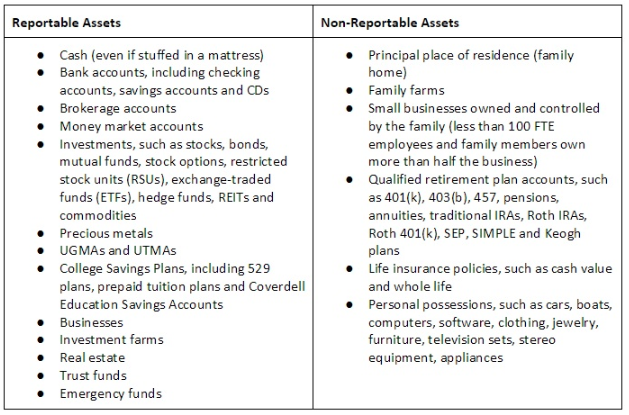
I of the most common mistakes on the FAFSA is to study retirement plans and internet home equity equally investments. These are non-reportable assets.
Information technology is also of import to distinguish assets from income. Money in a qualified retirement plan is ignored as an asset, simply contributions to and distributions from a qualified retirement plan during the base year count as income on the FAFSA. Some of the income may be taxable and some may be untaxed income, but both take the same impact on eligibility for demand-based aid. Fifty-fifty a tax-free return of contributions from a Roth IRA counts as income on the FAFSA.
Shifting an nugget from a reportable to a not-reportable status may sometimes lead to income, such every bit realizing capital letter gains when an investment is sold. Generally, it is all-time for this to occur prior to the base twelvemonth, so that information technology doesn't artificially inflate income.
In that location may likewise exist limits on the ability to employ a non-reportable nugget to shelter money on the FAFSA. For example, qualified retirement plans are usually subject area to annual contribution limits, so it may take several years to shelter a lot of money. On the other hand,contributions to an annuity may permit the family to shelter more money more quickly.
Insurance salespeople often encourage families to use a cash value or whole life insurance policy to shelter coin from financial assist formulas because they get paid loftier commissions. But, using a life insurance policy to shelter money is non recommended by contained fiscal directorate because such policies have loftier premiums, a low return on investment, and loftier surrender charges. The premiums are as well not deductible and the family volition have limited access to the money.
Trust funds often backfire. Trust funds are reportable as an asset, even if access to the principal is restricted. The master exception is when a courtroom placed involuntary restrictions on access to master, such as to pay for future medical expenses of an accident victim. If the restrictions came from the grantor who established the trust, the restrictions are considered voluntary. Some other exception is when buying of a trust is being contested, such equally a testamentary trust where the estate has not all the same been settled. As soon as the dispute is resolved, however, the trust is a reportable asset.
Note that loan proceeds count every bit an asset if the coin is unspent equally of the appointment the FAFSA is filed. But loans that are secured by a reportable asset are treated every bit reducing the internet worth of the asset. For example, the cyberspace worth of a brokerage account is reduced past the amount of any margin loans against the brokerage account. Any mortgages on the family dwelling house are ignored on the FAFSA because the family home is non a reportable asset. But, if the family owns a reportable asset, such equally a vacation dwelling or rental property, whatever mortgages that are secured by this investment existent estate will reduce the net worth of the asset. However, if the family used a mortgage on the family home to buy a vacation home, that mortgage does non reduce the net worth of the vacation abode because it is not secured by the vacation home.
A good strategy for sheltering avails is to employ them to pay downwards debt. Using assets to pay off credit card balances, auto loans and mortgages tin can not only make the money disappear, but it also represents skillful financial planning sense. If you're paying a much college interest rate on your credit cards than you lot're earning on your bank account, you will salvage money by paying off the loftier-rate debt since you lot will be paying less involvement.
The parents should as well consider accelerating necessary expenses.For instance, it is better to replace the roof on the family home before filing the FAFSA than soon later on. Necessary expenses may include maintenance items too as replacing a car or other equipment that is near the end of its normal life.
Although businesses are treated more than favorably than investments on the FAFSA, rental properties are normally considered investments, not businesses, unless they are role of a formally recognized concern that provides additional services (eastward.g., maid service at a hotel). A vacation home is considered an investment, even if y'all rent information technology out for part of the yr.
Intentions for the use of money don't matter. For example, if you lot sell your home and intend to use the proceeds to buy a new dwelling house, you lot must all the same report the proceeds as an asset until yous are legally committed to buying the new abode. Similarly, intending to use the money to pay for retirement does non affair, not even if you are already over retirement historic period.
Assets owned by a younger sibling are not reported on your FAFSA, but may be reported on the CSS/Financial Assistance PROFILE form. However, money in a 529 college savings plan, prepaid tuition plan or Coverdell pedagogy savings account is reported as a parent asset if the parent or the kid is the account owner. Shifting avails to a sibling may have express utility in sheltering it from need analysis unless the sibling will non exist going to higher (e.one thousand., a special needs trust).
529 college savings plans, prepaid tuition plans and Coverdell teaching savings accounts are not reported as an nugget on the FAFSA if they are endemic by someone other than the student or the custodial parent, such as a grandparent, aunt, uncle, cousin, older sibling or not-custodial parent. Withal, any distributions from such a program must be reported as untaxed income to the beneficiary on the subsequent year's FAFSA.
Can I Use A 529 College Savings Plan?
It is usually meliorate for relatives to wait until after the educatee graduates to give the pupil a graduation present to pay downward his or her educatee loans. That prevents the money from pain the student's eligibility for need-based financial aid.
There are a few workarounds when a college savings program is not reported every bit an nugget on the FAFSA. One is to change the account possessor to the parent or student. Another is waiting until later on the FAFSA is filed for the inferior twelvemonth in higher, when there is no subsequent year's FAFSA to be affected by the income, bold that the student will not be immediately going on to graduate or professional school within two years of graduating from undergraduate school. Another solution is to rollover one year's funds at a time to a parent-endemic higher savings plan after the FAFSA is filed but earlier taking a distribution to pay for higher costs. Information technology may be necessary to have the parent-owned 529 plan be in the same land equally the grandparent-endemic 529 plan to avoid recapture rules. Finally, one tin take a non-qualified distribution afterward graduation to pay down debt. A not-qualified distribution will exist subject to ordinary income revenue enhancement at the casher'due south rate plus a ten pct tax penalty, just simply on the earnings portion of the distribution.
Strategic Positioning of Assets
Student assets are assessed more heavily than parent assets on the FAFSA. A portion of parent avails are sheltered by an nugget protection allowance that is based on the age of the older parent. Any remaining assets are assessed on a bracketed calibration from 2.64 percent to five.64 percent. Student assets, such as custodial (UGMA or UTMA) depository financial institution and brokerage accounts, are assessed at a flat rate of 20 percent, with no asset protection allowance. In a worst example scenario, each $10,000 in the student's name volition reduce eligibility for need-based aid past $two,000, compared with $564 for each $10,000 in the parent's name.
Note that the asset protection allowance has been decreasing rapidly since 2009-2010 and may disappear entirely in merely a few more years if Congress does non act to fix the problem. Even so, parent assets will withal have less of an touch on assist eligibility than student assets.
Clearly, it is better for parents to save for college in their name than in the student'southward name.
So, 1 strategy for improving assistance eligibility is to shift avails from the educatee's proper noun to the parent'south name. The best approach is to move the money into the custodial version of a 529 higher savings plan. This 529 plan is titled the same every bit the original UGMA or UTMA business relationship, with the student as both account owner and beneficiary. Unlike a regular 529 program, the beneficiary cannot be changed. Only, since July i, 2009, custodial 529 higher savings plans have been reported equally a parent nugget on the FAFSA is the student is a dependent student. This yields a more favorable fiscal assist treatment.
Note that contributions to 529 plans must be fabricated in cash, so the UGMA or UTMA business relationship will need to exist liquidated get-go. If this will yield majuscule gains, information technology is important to either offset them with capital losses or have them occur before the base of operations twelvemonth, so that they do not artificially increment income.
One cannot but move the money into the parent's proper noun, as legally the money is the belongings of the child. However, one can spend the child's coin for the do good of the kid and prepare aside a similar amount of parent money at the same time. For instance, 1 could spend the money on necessary expenses for the child that are not parental obligations, such equally test prep classes, a car to commute to college, a laptop or tablet calculator, calculator software, a dorm refrigerator and a dorm microwave oven.
Simplified Needs Examination
The simplified needs test will disregard all assets on the FAFSA if parent adjusted gross income is less than $50,000 and the family satisfies one of 3 additional criteria:
- The parents were eligible to file an IRS Form 1040A or 1040EZ (or not required to file a federal income taxation return)
- Someone in the household received sure means-tested federal benefits within the last 2 years. These ways-tested federal benefits include SNAP, TANF, WIC, SSI or Free and Reduced Price Schoolhouse Luncheon.
- Either parent is a dislocated worker
Spend Assets Strategically
If there are leftover assets in the educatee's and parent'due south names, it is best to spend down the student'due south assets first to pay for college before using any of the parent's assets. That will forbid the pupil'south avails from affecting help eligibility in a subsequent year.
When taking a distribution from a 529 college savings plan to pay for higher costs, be sure to carve out $4,000 in tuition and textbook expenses that volition be paid for with cash or loans. IRS rules do not allow double-dipping, so you can't utilize the same qualified higher pedagogy expenses to justify both a tax-gratuitous distribution from a 529 college savings programme and the American Opportunity Tax Credit (AOTC). If the family will qualify for both, the AOTC is worth more per dollar of qualified expenses, even when compared with the income tax and revenue enhancement penalization on a non-qualified distribution from a 529 college savings plan, considering merely the earnings portion of a 529 plan distribution is potentially taxable.
colemanthishatthe.blogspot.com
Source: https://www.cappex.com/articles/money/how-to-shelter-assets-on-the-fafsa
0 Response to "Why Small Businesses Owned and Controlled by Your Family Doesn't Count in Fafsa"
Post a Comment